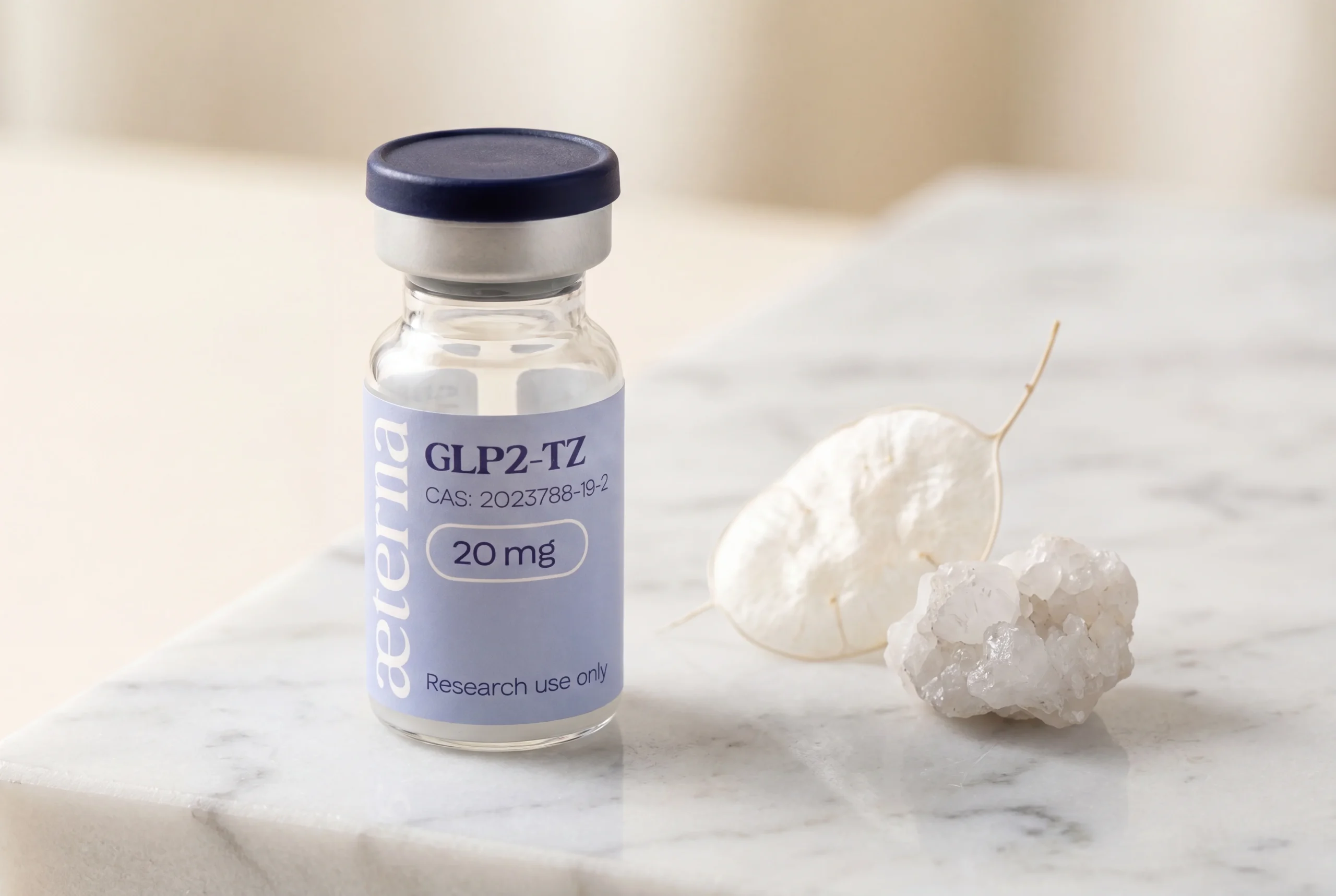
Tirzepatide
Aeterna does not sell peptides. External link, vendor independently verified.
Mechanism
Tirzepatide does not simply amplify a single hormonal pathway. It occupies two distinct receptor families simultaneously – GLP-1R and GIPR – with a pharmacological profile engineered to favor neither at the expense of the other. The result is a convergence of complementary satiety and metabolic signals that, in clinical observation, produces effects exceeding what either agonist achieves alone. Understanding the mechanism requires holding two receptor vocabularies at once.
GLP-1 receptor agonism drives the familiar cascade: glucose-dependent insulin secretion, glucagon suppression, delayed gastric emptying, and hypothalamic satiety signaling. This is the same axis engaged by semaglutide.
GIP receptor co-agonism is the defining structural feature of tirzepatide, synergistically amplifying insulin release while modulating adipocyte lipid handling. The dual engagement produces effects that exceed what either monoagonist achieves alone.
Adipose GIPR signaling reorganizes peripheral fat metabolism, reducing lipotoxicity and improving tissue-level insulin sensitivity. This is the mechanistic edge tirzepatide holds over pure GLP-1 monotherapy.
GLP-1R and GIPR populations overlap in the hypothalamus and brainstem, and co-activation engages reward and satiety circuits more completely than either pathway alone. The result is a central signal that reinforces the peripheral one.
What we observe
What people lost in weight and A1C
The SURPASS and SURMOUNT trial programs represent among the most extensive metabolic intervention datasets assembled for a single compound. What follows reflects patterns reported in peer-reviewed literature under controlled conditions. They do not constitute predictions for any individual. Aeterna does not prescribe, dispense, or sell; this summary exists to illuminate the evidence, not to direct its application.
01
Glycemic moderation
02
Body weight reduction
03
Fasting insulin and HOMA-IR
04
Lipid architecture
05
Blood pressure
06
Cardiovascular event reduction
Evidence
What the trials found
Three studies anchor the current evidence base for tirzepatide in humans. Each is cited with its primary finding and a representative statistic. These entries reflect the literature available through early 2025; readers are encouraged to consult primary sources directly.
Tirzepatide Once Weekly for the Treatment of Obesity (SURMOUNT-1)
A 72-week, double-blind, randomized, placebo-controlled trial enrolling 2,539 adults with obesity or overweight and at least one weight-related comorbidity but without type 2 diabetes. Participants receiving 15 mg tirzepatide weekly achieved a mean weight reduction of 20.9% from baseline. All active doses demonstrated statistically significant superiority over placebo across primary and key secondary endpoints, including waist circumference, blood pressure, and lipid parameters.
Tirzepatide versus Semaglutide Once Weekly in Patients with Type 2 Diabetes (SURPASS-2)
A 40-week, open-label, randomized trial of 1,879 adults with type 2 diabetes inadequately controlled on metformin. Tirzepatide at 10 mg and 15 mg produced statistically superior reductions in HbA1c and body weight compared with semaglutide 1 mg. The 15 mg dose achieved a mean HbA1c reduction of 2.46 percentage points and a mean weight reduction of 12.4 kg – both exceeding the semaglutide comparator arm.
Tirzepatide for Metabolic Dysfunction-Associated Steatohepatitis: Interim Analysis of the SYNERGY-NASH Trial
An interim analysis of a Phase II, randomized, double-blind trial examining tirzepatide’s effects on liver histology in adults with biopsy-confirmed MASH (metabolic dysfunction-associated steatohepatitis). At 52 weeks, 62% of participants in the 15 mg arm achieved MASH resolution without worsening of fibrosis, compared with 10% in the placebo arm – a finding that substantially broadened the compound’s studied therapeutic scope beyond glycemia and adiposity.
From lyophilized powder to a usable solution.
Peptide
5 mg lyophilized powder
Diluent
2.0 mL bacteriostatic water
Final concentration
2.5 mg/mL
01
Prepare the vial
02
Draw the diluent
03
Add slowly
04
Prepare the vial
Note
Dosing rythm
A patient titration
Schedule below mirrors the peptidedosages.com educational protocol (typical daily range: 2.5–15 mg once weekly (gradual 4‑week titration steps)).
Storage, caution, contradiction
Storage
Cold, dark, undisturbed
- Lyophilized: freeze at −20 °C (−4 °F).
- After reconstitution, refrigerate at 2–8 °C (35.6–46.4 °F).
- Use within 28 days.
- Do not use if solution appears cloudy, discolored, or contains visible particulate matter.
- Discard any unused reconstituted solution after 28 days regardless of apparent condition.
Side effects
What members describe
- Nausea and vomiting - most common adverse events; typically dose-dependent and transient, peaking during escalation phases.
- Diarrhea and constipation - gastrointestinal motility effects consistent with GLP-1R-mediated gastric emptying delay.
- Injection-site reactions - erythema, pruritus, or mild induration; rotate injection sites systematically.
- Hypoglycemia - risk is low as monotherapy but increases meaningfully when combined with insulin secretagogues or exogenous insulin.
- Decreased appetite and early satiety - pharmacodynamically expected; monitor for inadequate caloric intake in lean individuals.
Contradictions
Reasons to abstain
- Personal or family history of medullary thyroid carcinoma - GLP-1R agonism has been associated with C-cell hyperplasia in rodent models; clinical significance in humans remains under study but warrants caution.
- Multiple endocrine neoplasia syndrome type 2 (MEN 2) - contraindicated in approved labeling.
- History of pancreatitis - incretin-based therapies carry a class-level signal; causality remains debated but the association warrants clinical judgment.
- Severe gastroparesis or gastric motility disorders - gastric emptying delay may exacerbate existing conditions.
- Pregnancy and lactation - safety data are absent; use is not appropriate in these populations.
Synergies
What pairs with Tirzepatide
Tirzepatide’s dual-incretin architecture already integrates two complementary signals. Additions to any protocol should be deliberate, evidence-informed, and supervised. The following companions appear in research literature alongside incretin-based interventions. Aeterna does not prescribe combinations; these pairings are educational observations only.
FAQ
Your questions, patiently answered
Semaglutide is a selective GLP-1 receptor agonist. Tirzepatide adds co-agonism at the GIP receptor – a structurally distinct incretin pathway. In head-to-head trials (SURPASS-2), tirzepatide at 10 mg and 15 mg produced statistically superior reductions in both HbA1c and body weight compared with semaglutide 1 mg. Whether this advantage persists against higher semaglutide doses (2.4 mg, as used in obesity indications) is the subject of ongoing comparative research.
This is one of the more intellectually interesting questions in contemporary incretin pharmacology. Early observations suggested that GIP promoted fat storage, leading some researchers to propose GIPR antagonism as a therapeutic strategy. Tirzepatide’s clinical results – and subsequent mechanistic work – suggest that the relationship is context-dependent: chronic, high-affinity GIPR agonism in the setting of GLP-1R co-activation appears to produce net metabolic benefit. The precise mechanism, particularly in adipose tissue, remains an active area of investigation.
The FDA approved tirzepatide under the trade name Zepbound in November 2023 for chronic weight management in adults with obesity (BMI ≥30) or overweight (BMI ≥27) with at least one weight-related comorbidity. The SURMOUNT-1 trial, which established this indication, enrolled participants without type 2 diabetes. Appropriateness for any individual is a clinical determination. Aeterna does not prescribe.
Tirzepatide’s extended half-life – approximately five days, enabling once-weekly dosing – is achieved through conjugation of a C18 fatty diacid chain to a lysine residue at position 20 of the peptide. This modification promotes reversible albumin binding in plasma, slowing renal clearance and proteolytic degradation. The approach is analogous to, but structurally distinct from, the fatty acid modifications used in semaglutide’s design.
The SYNERGY-NASH interim analysis reported a 62% MASH resolution rate at 52 weeks in the 15 mg cohort – a finding that positions tirzepatide as a candidate intervention in metabolic liver disease beyond its glycemic and adiposity indications. The mechanism likely involves a combination of direct hepatic GIPR and GLP-1R signaling, reduced lipotoxicity from weight loss, and improved insulin sensitivity. Full trial results are anticipated to further define this dimension of the compound’s profile.
The structured escalation protocol – beginning at 2.5 mg and advancing in 2.5 mg increments no faster than every four weeks – exists precisely to moderate GI tolerability. Clinical experience suggests that eating smaller, lower-fat meals, avoiding recumbency immediately after injection, and timing injections consistently (same day each week) reduces symptom burden. Persistent or severe symptoms warrant clinical evaluation. Aeterna does not provide medical management guidance.
In the same family
Further reading in the curriculum.
Sourcing · Independently verified
When you're ready, source thoughtfully.