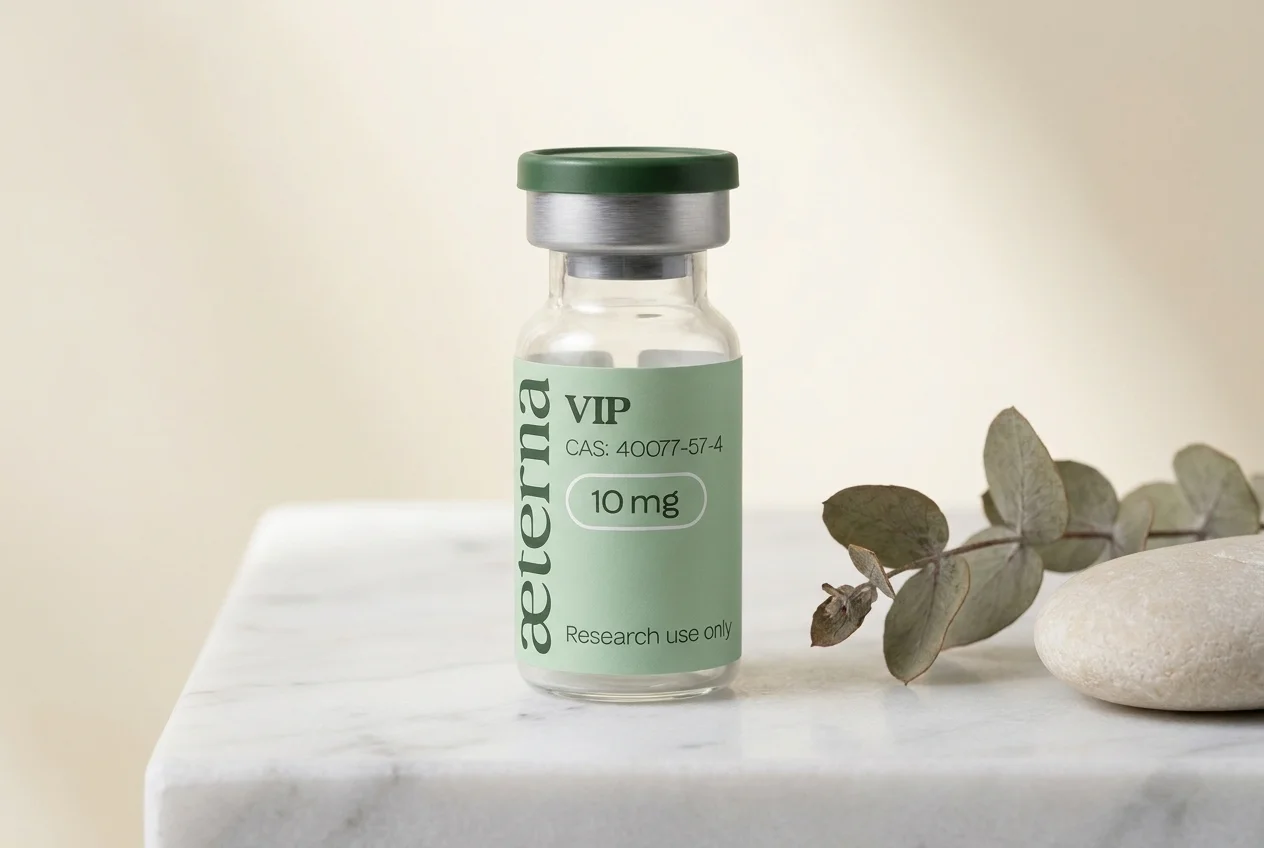
VIP
Aeterna does not sell peptides. External link, vendor independently verified.
Mechanism
VIP is not a pharmaceutical invention. It is an endogenous neuropeptide synthesized throughout the central and peripheral nervous systems, the gastrointestinal tract, and immune tissues. Its conservation across vertebrate species – and the breadth of its receptor distribution – suggests a signaling role that predates most of the pharmacological vocabulary we use to describe it. Understanding VIP means understanding how a single molecule can simultaneously modulate vascular tone, immune activation, and neuronal survival.
VPAC receptor signaling begins when vasoactive intestinal peptide binds VPAC1 and VPAC2, activating Gs-coupled cAMP pathways across multiple tissues. This receptor system is distributed throughout the gastrointestinal, pulmonary, cardiovascular, and nervous systems, which helps explain VIP’s unusually broad physiological reach.
Smooth muscle and secretory regulation are central to VIP’s peripheral effects in the gut and airways. In gastrointestinal tissue it promotes smooth muscle relaxation and water and electrolyte secretion, while in the lung it functions as both a bronchodilator and an anti-inflammatory signal.
Clinical investigation has focused on inflammatory and vascular conditions in which VIP’s immunomodulatory and vasodilatory properties may be relevant. Published work has included studies in sarcoidosis, pulmonary hypertension, and inflammatory lung disease, including Phase II evaluation of aerosolized VIP in sarcoidosis-related pulmonary inflammation.
Delivery constraints shape nearly every serious discussion of VIP as a therapeutic candidate. Intranasal administration appears to provide limited central nervous system access, but the native peptide’s circulating half-life of roughly 1 to 2 minutes remains a major formulation and dosing challenge.
What we observe
What changed with VIP in studies
The outcomes attributed to VIP in peer-reviewed literature span vascular, immunological, and neurological domains. No single study captures the full picture; the patterns described here represent convergent findings across preclinical models and early-phase human trials. Aeterna does not prescribe, dispense, or sell. What follows is a reading of the evidence as it stands.
01
Pulmonary Resistance
02
Cytokine Suppression
03
Regulatory T Cells
04
Neuroimmune Modulation
05
Airway Relaxation
06
Sleep Architecture
Evidence
VIP trials and findings
Three studies are presented here as representative entries in a larger literature. They are not exhaustive. The field spans decades and disciplines – from gastroenterology to pulmonology to neuroimmunology. Each study is cited for its methodological contribution, not as proof of clinical efficacy in any individual context.
Inhaled Vasoactive Intestinal Peptide in Pulmonary Arterial Hypertension: A Randomized, Double-Blind, Placebo-Controlled Trial
Patients with idiopathic PAH receiving inhaled VIP (200 µg four times daily for 12 weeks) demonstrated significant reductions in pulmonary vascular resistance and mean pulmonary arterial pressure compared to placebo. Exercise capacity, measured by six-minute walk distance, improved in the VIP group. The peptide was well tolerated, with transient facial flushing as the most commonly reported adverse event. Authors noted the short half-life of VIP necessitated frequent dosing intervals and highlighted the need for longer-acting analogues.
Vasoactive Intestinal Peptide Generates CD4+CD25+ Regulatory T Cells In Vivo and Suppresses Experimental Colitis via VPAC1-Dependent Signaling
Systemic VIP administration in a murine model of TNBS-induced colitis significantly expanded the FoxP3+ regulatory T cell population in mesenteric lymph nodes and reduced colonic histological damage scores. VPAC1-deficient mice showed attenuated Treg induction, confirming receptor specificity. IL-10 levels in colonic tissue were elevated threefold in VIP-treated animals. The authors proposed VPAC1 agonism as a tractable target for inflammatory bowel disease therapeutics.
Intranasal VIP Attenuates Neuroinflammation and Preserves Dopaminergic Neurons in a Murine Model of Parkinson's Disease
Intranasal delivery of VIP (10 µg/day for 21 days) in MPTP-lesioned mice reduced microglial activation in the substantia nigra, lowered striatal TNF-α and IL-1β concentrations, and preserved approximately 40% more tyrosine hydroxylase-positive neurons compared to saline controls. Behavioral assessments showed improved rotarod performance in treated animals. The intranasal route was associated with detectable VIP levels in olfactory bulb and striatum, supporting CNS bioavailability via the olfactory-to-brain pathway.
From lyophilized powder to a usable solution.
Peptide
1 mg · 5 mg (research vials)
Diluent
Bacteriostatic water (SC/intranasal); sterile 0.9% saline (IV)
Final concentration
500 µg/mL (standard); 1 mg/mL (concentrated intranasal preparations)
01
Prepare the vial
02
Draw the diluent
03
Add slowly
04
Prepare the vial
Note
Dosing rythm
A patient titration
The dosing patterns below are drawn from published investigational protocols and preclinical literature. They do not constitute medical advice. VIP’s ultrashort plasma half-life means that dosing frequency and delivery route are as consequential as dose magnitude. Intranasal administration exploits olfactory transport to extend CNS exposure beyond what plasma kinetics would suggest. Any protocol should be developed in consultation with a qualified physician familiar with the peptide’s pharmacology.
Storage, caution, contradiction
Storage
Cold, dark, undisturbed
- Store lyophilized powder at −20°C, protected from light and moisture, for up to 24 months.
- Once reconstituted, refrigerate at 2–8°C and use within 7 days; do not freeze reconstituted solution.
- Avoid repeated freeze-thaw cycles; peptide integrity degrades measurably after two cycles.
- Protect reconstituted solution from direct light; amber vials or foil wrapping are appropriate for extended storage.
- Discard any solution showing particulate matter, cloudiness, or discoloration prior to use.
Side effects
What members describe
- Transient facial flushing and warmth, particularly with inhaled or intravenous administration, reflecting vasodilatory mechanism.
- Hypotension, especially with IV infusion at higher doses; blood pressure monitoring is standard in clinical protocols.
- Nausea and mild gastrointestinal discomfort reported in a subset of subjects receiving systemic administration.
- Transient headache, likely secondary to cerebrovascular vasodilation, noted in intranasal and IV protocols.
- Local irritation at injection site with subcutaneous administration; rotate sites to minimize tissue response.
Contradictions
Reasons to abstain
- Known hypersensitivity to VIP or any component of the formulation; anaphylaxis has been reported rarely.
- Severe hypotension or hemodynamic instability; VIP's vasodilatory action may exacerbate cardiovascular compromise.
- Concurrent use of potent vasodilators (e.g., sildenafil, prostacyclin analogues) without hemodynamic monitoring, given additive hypotensive potential.
- Active systemic infection; broad immunomodulatory suppression of innate responses may impair pathogen clearance.
- Pregnancy and lactation; no adequate safety data exist in human gestational populations.
Synergies
What goes well with VIP
VIP is rarely studied in isolation from the broader neuropeptide and immunomodulatory landscape. The companions listed here reflect published co-investigation patterns and mechanistic complementarity – not clinical prescriptions. Each pairing addresses a distinct dimension of the signaling architecture VIP inhabits. Aeterna does not prescribe, dispense, or sell.
FAQ
Your questions, patiently answered
The name reflects its site of discovery (porcine intestine) and its first characterized action (vasodilation), but it is misleading as a summary. VIP is now understood as a pleiotropic neuropeptide expressed throughout the nervous system, immune tissues, lungs, and reproductive organs. Its gastrointestinal role – regulating motility, secretion, and mucosal immunity – is one chapter in a much longer story.
VIP is cleaved rapidly by dipeptidyl peptidase IV (DPP-IV) and neutral endopeptidase (NEP) in plasma, yielding a half-life of approximately two minutes. This limits systemic exposure after injection but does not eliminate therapeutic potential. Inhaled and intranasal routes bypass first-pass degradation; intranasal delivery exploits olfactory axonal transport to achieve CNS concentrations disproportionate to plasma levels. Analogue development – including DPP-IV-resistant variants and PEGylated conjugates – is an active area of research.
VIP modulates rather than globally suppresses immunity. It reduces pro-inflammatory cytokine production and promotes regulatory T cell expansion, but it does not impair pathogen-specific adaptive responses in the way that broad immunosuppressants do. That said, in the context of active systemic infection, its dampening of innate inflammatory signaling warrants caution. The distinction between immunomodulation and immunosuppression is meaningful here, and the literature treats it carefully.
A randomized, double-blind, placebo-controlled trial published in the American Journal of Respiratory and Critical Care Medicine (2004) demonstrated significant reductions in pulmonary vascular resistance and improvements in six-minute walk distance with inhaled VIP at 200 µg four times daily over 12 weeks. Subsequent work has explored longer-acting inhaled formulations. VIP holds FDA Orphan Drug designation for PAH, reflecting the unmet need and the mechanistic rationale, though it has not achieved regulatory approval as a therapeutic agent.
VIP and PACAP-38 share approximately 68% sequence homology and bind the same VPAC1 and VPAC2 receptors with similar affinity. The key distinction is PAC1: PACAP binds PAC1 with high affinity, while VIP does so only weakly. PAC1 mediates many of PACAP’s neuroprotective and neurotrophic effects. The two peptides are therefore complementary rather than interchangeable – VIP’s immunomodulatory profile is broader at VPAC1; PACAP’s neuroprotective reach extends further through PAC1.
Human data remain limited but are accumulating. Small clinical studies in rheumatoid arthritis have reported reductions in synovial inflammatory markers following VIP administration. Observational data in Crohn’s disease patients show inverse correlations between mucosal VIP expression and disease activity. Phase II trials in inflammatory bowel disease have been initiated at several European centers. The preclinical mechanistic case is strong; the clinical translation is at an early but active stage.
In the same family
Further reading in the curriculum.
Sourcing · Independently verified
When you're ready, source thoughtfully.