Impact-Site-Verification: 7eedfd50-956e-4d75-a83e-7b25ea0ee31d

Monograph № 009

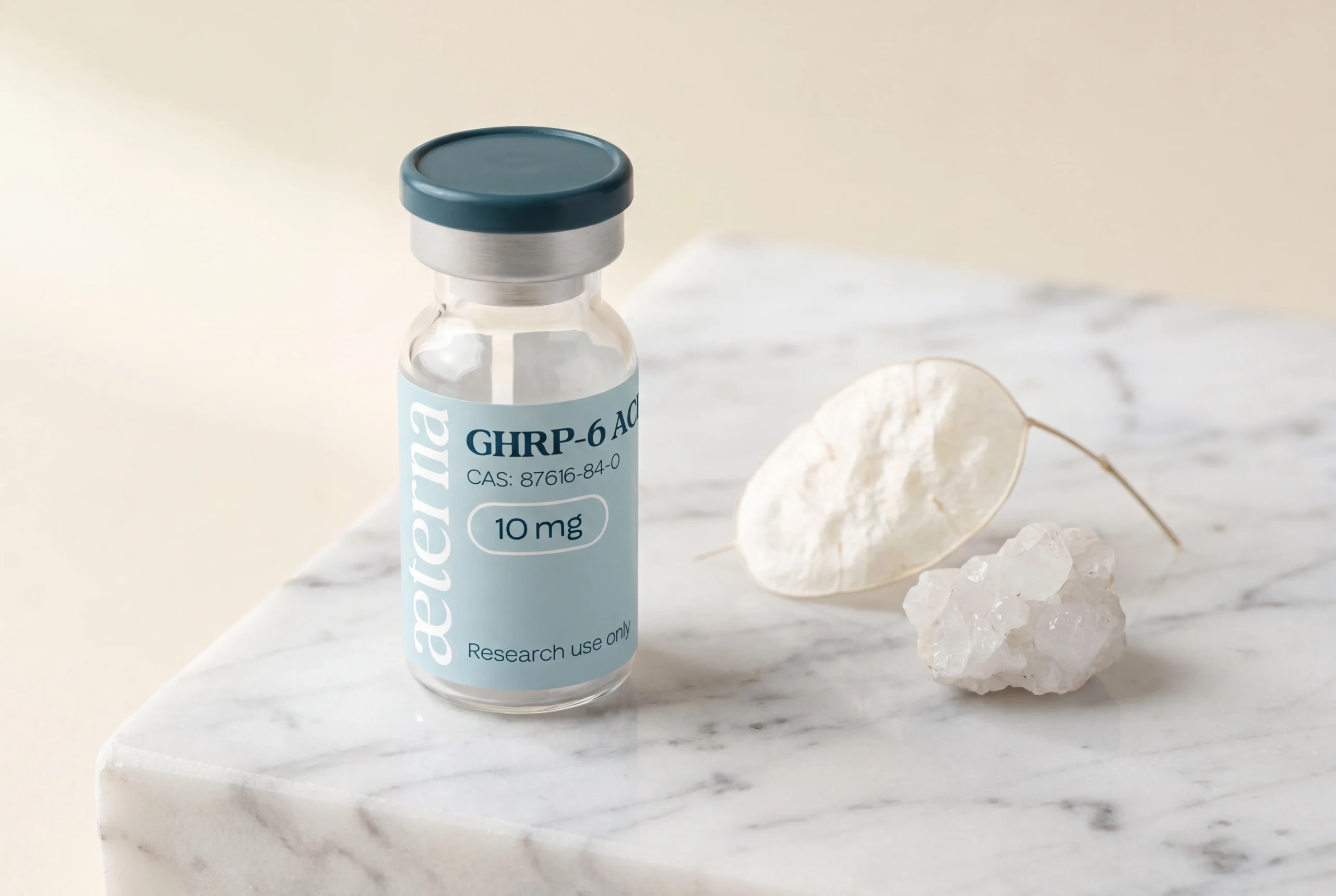
GHRP-6 Acetate

A six-residue hexapeptide that mimics the body’s own secretagogue signal, engaging the pituitary axis the field has spent four decades learning to read.
Sequence
6 amino acids
Half-life
15–60 min (biphasic)
Route
Subcutaneous · Intranasal

Aeterna does not sell peptides. External link, vendor independently verified.

Originator
Cyril Y. Bowers
Tulane University, New Orleans · synthesized 1980; foundational GHSR pharmacology established 1984
First disclosed
1984
First peer-reviewed disclosure: Bowers CY et al., Endocrinology, Vol. 114, No. 5, pp. 1537–1545, May 1984, Johns Hopkins University School of Medicine, Baltimore, Maryland
Regulatory status
Research Use Only
No IND filed for GHRP-6 as a standalone therapeutic; foundational pharmacology underpins GHRP-2 and ipamorelin clinical programs
Studied for
GH Secretion · Appetite · Cytoprotection
Investigated across pituitary physiology, cardiac cytoprotection, and cachexia models; literature spans Endocrinology, JCEM, and Peptides (1984–2024)

Mechanism

What GHRP-6 does in the pituitary

GHRP-6 does not introduce a foreign instruction. It speaks in a dialect the hypothalamic-pituitary axis evolved to receive – mimicking ghrelin’s secretagogue function with a synthetic hexapeptide that binds the growth hormone secretagogue receptor with high affinity. The result is a coordinated, pulsatile release of endogenous growth hormone rather than a pharmacological flood. Understanding that distinction is the beginning of understanding GHRP-6.

GHSR-1a agonism is the primary action of GHRP-6, binding pituitary somatotrophs, activating Gq-phospholipase C signaling, and triggering pulsatile GH exocytosis through intracellular calcium mobilization. Somatostatin tone and receptor desensitization impose a physiologic ceiling on the size of each pulse.

Hypothalamic co-signaling amplifies the pituitary response by augmenting endogenous GHRH release when GHRP-6 engages GHSR-1a on relevant hypothalamic neurons. This convergence of signals is the mechanistic basis for its frequent pairing with GHRH analogues in the literature.

Orexigenic signaling accounts for the compound’s characteristic hunger response, with GHSR-1a engagement in the hypothalamus and vagal afferents activating arcuate NPY/AgRP pathways. Among the GHRP series, this appetite effect is generally regarded as the most pronounced.

CD36-mediated activity represents a separate GH-independent pathway, with GHRP-6 binding CD36 on cardiomyocytes and activating Src-family kinase cascades that attenuate NF-κB-associated apoptosis in ischemia-reperfusion models. This mechanism is distinct from the somatotropic axis and is studied primarily in preclinical settings.

What we observe

Seen with GHRP-6: appetite and GH shifts

The outcomes attributed to GHRP-6 span pituitary endocrinology, body composition, appetite physiology, and cytoprotection. The patterns below reflect observations from peer-reviewed research, not clinical claims. Individual response is shaped by age, somatostatin tone, nutritional status, and concurrent signaling context.

01

Pulsatile GH Secretion

GHRP-6 reliably amplifies GH pulse amplitude in healthy subjects, with peak serum GH concentrations typically observed 15–30 minutes post-injection. The response is preserved across age groups, though blunted in subjects with elevated somatostatin tone or obesity.
Observed in controlled pharmacokinetic studies; magnitude varies with dose, fasting state, and baseline GH axis activity.

02

IGF-1 Elevation

Repeated GHRP-6 administration over days to weeks is associated with modest but measurable increases in circulating IGF-1, reflecting hepatic GH receptor activation downstream of the pituitary pulse. The effect is less pronounced than with continuous GH infusion, consistent with the physiological pulsatile pattern.
Reported in multi-week dosing studies; effect size dependent on dosing frequency and co-administration of GHRH analogues.

03

Appetite Stimulation

Appetite increase is among the most consistently reported effects of GHRP-6 – a direct consequence of GHSR-1a agonism in hypothalamic orexigenic circuits. In cachexia and wasting models, this property has been studied as a therapeutic target rather than an adverse effect.
Mechanistically well-characterized; considered a primary pharmacological effect, not a side effect, in appetite-deficit contexts.

04

Lean Mass Preservation

In animal models of muscle wasting and in small human studies of GH-deficient populations, GHRP-6 administration is associated with attenuation of lean mass loss. The effect is attributed to downstream IGF-1 signaling and direct GH-mediated protein anabolic activity.
Human data limited to small cohorts; animal model findings are robust across multiple species and wasting etiologies.

05

Cardiac Cytoprotection

Preclinical studies in rodent ischemia-reperfusion models report reduced infarct size, preserved ejection fraction, and attenuated inflammatory infiltration following GHRP-6 pre-treatment. The mechanism appears partially independent of GH secretion, involving direct receptor-mediated anti-apoptotic signaling in cardiomyocytes.
Preclinical evidence only; no completed human cardiac trials. Mechanism is biologically plausible and actively investigated.

06

Sleep Architecture Support

GH secretion is physiologically coupled to slow-wave sleep; GHRP-6 administration in the evening hours has been associated in small studies with augmented nocturnal GH pulses and subjective improvements in sleep depth. The relationship is correlative rather than causal in the available literature.
Limited human data; effect likely mediated through GH pulse amplification rather than direct sleep-circuit action.

Evidence

The data on GHRP-6

GHRP-6 carries one of the longest research histories of any synthetic secretagogue, with four decades of published pharmacology spanning pituitary physiology, body composition, and cytoprotection. The studies below represent methodologically significant entries in that record. They are presented for educational orientation, not as a basis for clinical decision-making.

Journal of Clinical Endocrinology & Metabolism
1990

Growth Hormone-Releasing Peptide-6 Stimulates GH Secretion in Normal and Short-Stature Children

A dose-escalation study in 24 pediatric subjects demonstrated that subcutaneous GHRP-6 produced robust, dose-dependent GH pulses with peak responses at 100 µg/kg. Co-administration with GHRH produced supra-additive GH release, establishing the synergistic signaling model that has guided secretagogue combination research since.

3.4×
greater peak GH response with GHRP-6 + GHRH versus GHRH alone
Peptides
2003

GHRP-6 Reduces Myocardial Infarct Size and Preserves Cardiac Function in a Rat Ischemia-Reperfusion Model

Intravenous GHRP-6 administered prior to coronary occlusion in Sprague-Dawley rats reduced infarct area as a percentage of risk zone by approximately 38% compared to vehicle controls. Ejection fraction at 24 hours post-reperfusion was significantly preserved. Hypophysectomized animals showed comparable protection, indicating a GH-independent cytoprotective mechanism.

38%
reduction in infarct area versus vehicle in hypophysectomized rat model
European Journal of Endocrinology
1997

Repeated Administration of GHRP-6 Sustains GH Pulsatility and Elevates IGF-1 in Healthy Elderly Men

A four-week, double-blind, placebo-controlled study in 18 men aged 60–72 found that twice-daily subcutaneous GHRP-6 (1 µg/kg) maintained GH pulse amplitude without evidence of receptor desensitization and produced a statistically significant 28% increase in serum IGF-1 from baseline. Appetite scores increased in the active arm, consistent with GHSR-1a orexigenic activity.

28%
increase in serum IGF-1 from baseline after four weeks of twice-daily dosing in men aged 60–72
Reconstitution

From lyophilized powder to a usable solution.

Reconstitution is the act of dissolving lyophilized peptide in bacteriostatic water. Done correctly, it takes under two minutes.

Peptide

5 mg lyophilized powder

Diluent

3.0 mL bacteriostatic water

Final concentration

1.67 mg/mL

01

Prepare the vial

Allow the lyophilized vial to reach room temperature. Wipe the stopper with an alcohol swab. Do not shake the powder.

02

Draw the diluent

Using a sterile syringe, draw 1 mL of bacteriostatic water (0.9% benzyl alcohol). Use a fresh needle for the draw.

03

Add slowly

Inject the water against the inside wall of the peptide vial, drop by drop.

04

Prepare the vial

Rotate or shake the vial until the solution clears. It should be visually transparent within sixty seconds. You can wait up to 20 minutes.

Note

Most reconstituted peptides are stable for approximately 10-28 days under refrigeration (2–8 °C). Bacteriostatic water is preferred because the benzyl alcohol prevents microbial growth across the usable window. You can use sterile water with shorter timeframes.

Dosing rythm

A patient titration

Schedule below mirrors the peptidedosages.com educational protocol (typical daily range: 300–900 mcg total (split into 3 doses with gradual titration)).

For educational reference only. Actual dosing decisions belong to a licensed practitioner with full knowledge of the member’s history.
Weeks 1–2
100 mcg
Once daily · 6 units (0.06 mL)
Weeks 3–4
200 mcg
Once daily · 12 units (0.12 mL)
Weeks 5–12
300 mcg
Once daily · 18 units (0.18 mL)
Upper Research Range
300 µg maximum
per injection
Three times daily · Practical ceiling observed in literature
Handling

Storage, caution, contradiction

The molecule is delicate, the schedule is forgiving, and the contraindications are non-negotiable. Members are taught to take all three with equal seriousness.

Storage

Cold, dark, undisturbed

Side effects

What members describe

Contradictions

Reasons to abstain

Synergies

What goes well with GHRP-6

GHRP-6 is rarely studied in isolation in contemporary research protocols. Its most meaningful combinations are those where the mechanistic logic is explicit – where each compound addresses a distinct node in the same signaling architecture. The pairings below reflect patterns observed in the literature and in investigational practice. They are not prescriptions.

For educational reference only. Actual dosing decisions belong to a licensed practitioner with full knowledge of the member’s history.
The canonical pairing. CJC-1295 occupies the GHRH receptor while GHRP-6 occupies GHSR-1a; the two signals converge on the somatotroph and produce supra-additive GH release. The combination is the most extensively documented secretagogue stack in the literature.
GH Axis Amplification
BPC-157’s systemic tissue-repair signaling complements GHRP-6’s GH-mediated anabolic and cytoprotective effects. The combination is studied in models of musculoskeletal injury where both GH axis support and local repair signaling are relevant.
Tissue Repair · Cytoprotection
Ipamorelin offers GHSR-1a agonism with minimal cortisol and prolactin co-secretion – a cleaner GH pulse. Some protocols use low-dose GHRP-6 alongside ipamorelin to retain appetite-stimulating benefit while moderating the cortisol signal; the combination requires careful titration.
Selective GH Secretion
Sermorelin’s short half-life mirrors endogenous GHRH pulsatility; combined with GHRP-6, the pairing preserves the natural on-off rhythm of GH secretion more faithfully than longer-acting GHRH analogues. Preferred in protocols where axis preservation is the primary concern.
Physiological GH Pulsatility

FAQ

Your questions, patiently answered

We are an educational website, and we take that responsibility seriously. If your question is not here, write to us at [email protected]
How does GHRP-6 differ from ipamorelin if both target GHSR-1a?

Both are GHSR-1a agonists, but their selectivity profiles diverge meaningfully. GHRP-6 co-stimulates cortisol and prolactin secretion alongside GH – a consequence of its broader receptor engagement profile. Ipamorelin was specifically engineered to minimize these co-secretions, producing a cleaner GH pulse. GHRP-6’s appetite stimulation is also considerably more pronounced. Neither is universally superior; the choice depends on what the protocol is designed to study or address.

Because GHSR-1a is the canonical ghrelin receptor, and ghrelin is the body’s primary orexigenic peptide hormone. GHRP-6 binding at hypothalamic GHSR-1a activates NPY/AgRP orexigenic neurons – the same pathway that drives hunger before meals. This is not an off-target effect; it is a direct pharmacological consequence of the receptor being agonized. In cachexia research, this property is considered therapeutically useful. In other contexts, it requires dietary management.

Yes, substantially. Elevated blood glucose and free fatty acids both increase somatostatin tone, which blunts the GH pulse. The literature consistently shows that GHRP-6 administered in a fasted state produces significantly larger GH responses than post-prandial administration. A minimum two-hour fast before injection is the standard research protocol condition.

The available evidence does not support significant axis suppression at research doses. Unlike exogenous GH, which suppresses endogenous secretion via negative feedback, GHRP-6 works by amplifying the pituitary’s own release machinery. The four-week study in elderly men (European Journal of Endocrinology, 1997) found maintained GH pulsatility without desensitization. Prolonged high-dose use remains less well-characterized, and periodic cycling is a common investigational practice.

GHRP-6 Acetate refers to the acetate counter-ion paired with the hexapeptide in its lyophilized form – a standard pharmaceutical salt form that improves stability and solubility. The pharmacologically active moiety is the hexapeptide itself; the acetate contributes to formulation stability rather than receptor activity. The CAS number 87616-84-0 refers specifically to this salt form.

This is one of pharmacology’s more elegant reversals. GHRP-6 was synthesized in 1980 as a synthetic enkephalin analogue with unexpected GH-releasing properties. Its receptor – GHSR-1a – was identified and cloned in 1996. The endogenous ligand for that receptor, ghrelin, was not discovered until 1999 by Kojima et al. at Kurume University. GHRP-6 thus preceded the discovery of the very hormone it mimics – a synthetic key that revealed the lock, which then revealed the natural key. The historical sequence is a useful reminder that pharmacological tools often illuminate biology rather than merely exploit it.

In the same family

Further reading in the curriculum - adjacent peptides worth understanding.

Ipamorelin
Growth Hormone Secretagogue
The engineered successor to GHRP-6 – same receptor, narrower pharmacological footprint. Ipamorelin’s defining characteristic is its selectivity: GH secretion without meaningful cortisol or prolactin co-stimulation. The comparison between the two compounds illuminates what receptor selectivity costs and what it confers.
GHRH Analogue
GHRP-6’s most studied companion. CJC-1295 occupies the GHRH receptor while GHRP-6 occupies GHSR-1a – two distinct nodes in the same secretory circuit. Understanding their interaction is foundational to understanding how the GH axis can be engaged with precision rather than force.
BPC-157
Cytoprotective Peptide
Where GHRP-6’s cytoprotective literature is largely cardiac and largely preclinical, BPC-157 addresses tissue repair across a broader anatomical range. The two peptides share a non-GH-mediated protective dimension that makes their mechanistic comparison instructive for anyone studying peptide cytoprotection as a field.

Sourcing · Independently verified

When you're ready, source thoughtfully.

Aeterna does not sell peptides. We maintain a short list of vendors evaluated for purity, third-party testing, handling, and supply consistency. The button here links directly to the vendor we currently recommend.
External link · We receive no remuneration. Verify your prescription before sourcing.
Scroll to Top
Aeterna Method is an education-only platform. We do not sell, prescribe, or recommend the use of peptides, medications, or treatment protocols. All content on this website is provided solely for informational and educational purposes and should not be interpreted as medical advice, diagnosis, or treatment guidance. Always consult a qualified physician or licensed healthcare professional before adding peptides, medications, or related compounds to your health routine.