Impact-Site-Verification: 7eedfd50-956e-4d75-a83e-7b25ea0ee31d

Monograph № 021

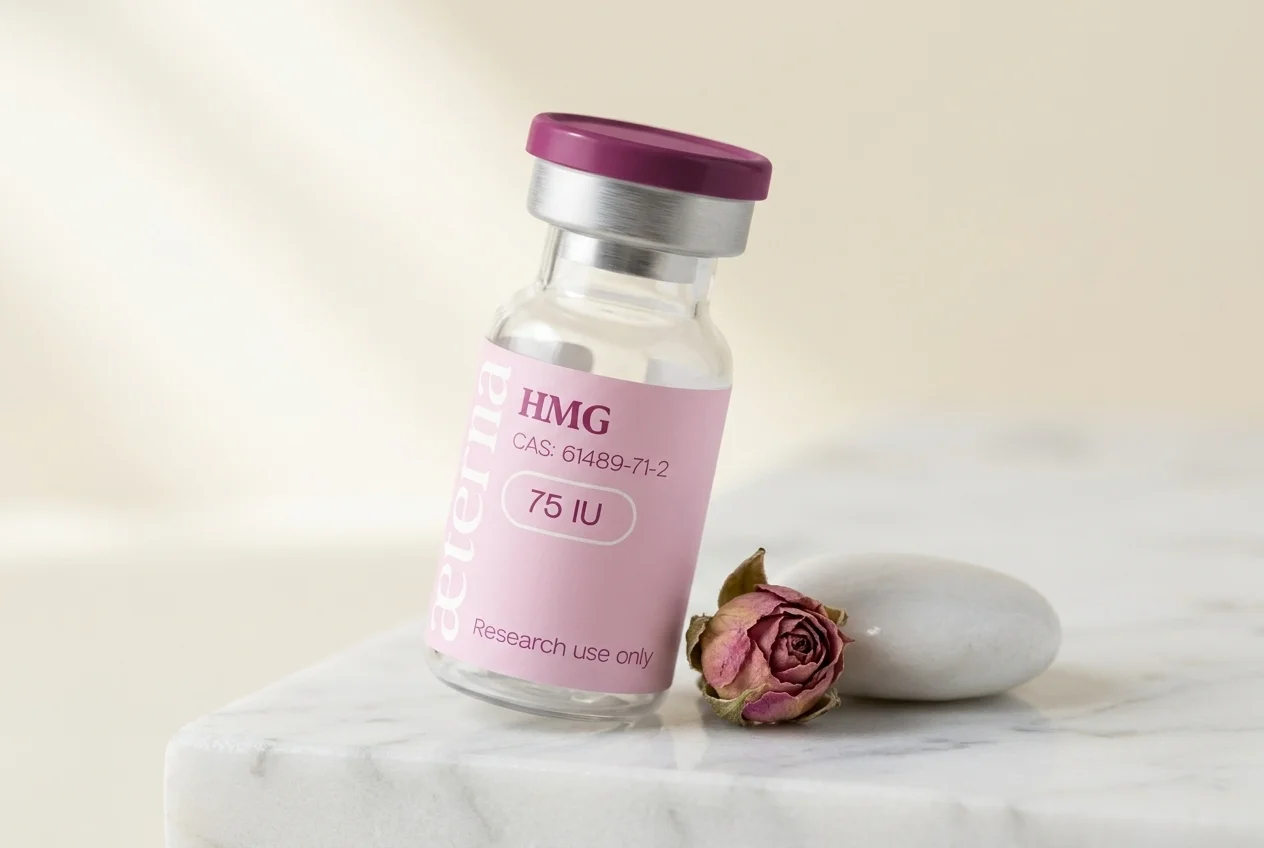
HMG

A purified extract carrying two of the body’s most fundamental reproductive signals at once, restoring the conversation between pituitary and gonad that recombinant biology has never fully replaced.
Sequence
Protein mixture (FSH + LH)
Half-life
FSH ~36 h · LH ~24 h
Route
Subcutaneous · Intramuscular

Aeterna does not sell peptides. External link, vendor independently verified.

Originator
Serono / IBSA
Developed for clinical fertility practice
First disclosed
1960s
Among the earliest gonadotropin preparations used in reproductive medicine
Regulatory status
Approved (various jurisdictions)
Licensed for ovulation induction and male hypogonadotropic hypogonadism
Studied for
Spermatogenesis · Ovulation Induction · Hypogonadotropic Hypogonadism
Decades of clinical literature across reproductive endocrinology

Mechanism

What HMG does for sperm and eggs

HMG – human menopausal gonadotropin – is not a synthetic peptide but a purified urinary extract containing both follicle-stimulating hormone and luteinizing hormone in approximately equal biological activity. Its mechanism is not novel invention; it is the restoration of a conversation the hypothalamic-pituitary-gonadal axis already knows how to conduct. Where endogenous gonadotropin secretion is absent or insufficient, HMG supplies the missing vocabulary.

FSH receptors on Sertoli and granulosa cells respond to the FSH component, initiating spermatogenesis in males and driving follicular maturation in females. Inhibin B and AMH dynamics reflect the downstream engagement of this axis.

LH receptors on Leydig and theca cells respond to the LH component, sustaining testosterone biosynthesis at intratesticular concentrations that serum levels alone cannot replicate. The combined gonadotropin signal recapitulates what the pituitary would otherwise provide.

In hypogonadotropic hypogonadism, the gonadal receptor architecture remains intact while the upstream pituitary signal is absent or insufficient. HMG substitutes directly for that missing signal, bypassing the failure without requiring hypothalamic or pituitary correction.

Both steroidogenic and gametogenic pathways proceed through cAMP and PKA activation, StAR induction, and CYP enzyme engagement. The dual FSH and LH composition addresses both arms of gonadal function simultaneously rather than requiring sequential or separate agents.

What we observe

Changes seen in ovulation and sperm count

The clinical record for HMG spans more than five decades across male and female reproductive endocrinology. Patterns reported in that literature are summarized here. Aeterna does not prescribe, dispense, or sell; these observations are drawn from published clinical studies and presented for educational purposes only.

01

Spermatogenesis Induction

In men with hypogonadotropic hypogonadism, combined HMG and hCG therapy has been associated with the induction of spermatogenesis in a substantial proportion of previously azoospermic individuals. The literature consistently identifies prior testicular volume and the presence of cryptorchidism as modifying variables.
Observed in controlled clinical series; individual response varies with etiology and baseline testicular architecture.

02

Intratesticular Testosterone Restoration

Unlike systemic testosterone replacement, HMG-based protocols restore intratesticular testosterone to concentrations sufficient for spermatogenesis. Studies measuring testicular fluid androgen levels report values orders of magnitude above serum concentrations – a gradient that exogenous testosterone cannot replicate.
Mechanistic distinction well-supported in the literature; clinical significance depends on fertility intent.

03

Follicular Development in Women

In women undergoing ovulation induction or controlled ovarian stimulation, HMG promotes multi-follicular development with a response profile comparable to recombinant FSH preparations. Some protocols favor HMG for its LH co-activity, particularly in patients with low endogenous LH.
Comparative data exist; protocol selection remains a matter of clinical judgment and individual response.

04

Testicular Volume Recovery

Prolonged gonadotropin therapy in hypogonadotropic men has been associated with measurable increases in testicular volume over treatment courses of six to twenty-four months. Volume recovery correlates imperfectly but meaningfully with spermatogenic response.
Reported in longitudinal case series; timeline and magnitude vary considerably between individuals.

05

Hormonal Axis Priming

In adolescent males with delayed puberty attributable to gonadotropin deficiency, HMG-based regimens have been studied as a means of initiating testicular development and establishing the hormonal milieu of puberty. The literature suggests that early intervention may preserve greater spermatogenic potential.
Emerging area; long-term comparative data remain limited.

06

Preservation of Fertility During Testosterone Therapy Transition

Some clinicians have employed HMG as a bridge or adjunct when transitioning patients off exogenous testosterone, with the aim of restoring gonadotropin-dependent spermatogenesis before or during that transition. The evidence base for this application is observational rather than randomized.
Observational data only; no randomized controlled trials specifically address this indication.

Evidence

The data on HMG

The evidentiary record for HMG is among the longest in reproductive endocrinology, encompassing both male fertility and ovarian stimulation populations. Selected studies below represent the range of endpoints examined. Statistics are drawn from published reports; readers are encouraged to consult primary sources directly.

Journal of Clinical Endocrinology & Metabolism
2009

Gonadotropin Therapy for Male Hypogonadotropic Hypogonadism: Predictors of Spermatogenic Response

A prospective cohort of 89 men with hypogonadotropic hypogonadism received combined hCG and HMG therapy for up to 24 months. Spermatogenesis was induced in 76% of participants. Baseline testicular volume above 4 mL and absence of cryptorchidism were the strongest predictors of successful sperm production. Median time to first sperm detection was 7.4 months.

76%
of hypogonadotropic men achieved measurable spermatogenesis with combined hCG/HMG therapy over 24 months.
Human Reproduction
2015

Recombinant FSH Versus Human Menopausal Gonadotropin for Controlled Ovarian Stimulation: A Randomized Comparison of Oocyte Yield and Embryo Quality

In a randomized trial of 214 women undergoing IVF, HMG and recombinant FSH produced comparable numbers of mature oocytes (mean 9.1 vs. 9.4, respectively). HMG was associated with a modestly higher proportion of top-quality embryos on day 3, a finding the authors attributed to the LH co-activity of the HMG preparation. Clinical pregnancy rates did not differ significantly between groups.

9.1
mean mature oocytes retrieved with HMG stimulation, comparable to recombinant FSH in a randomized IVF cohort.
Fertility and Sterility
2019

Intratesticular Testosterone Concentrations During Gonadotropin Replacement: HMG Versus Testosterone Enanthate in Hypogonadal Men

A crossover study in 28 men with secondary hypogonadism compared intratesticular testosterone concentrations during HMG-based gonadotropin replacement versus intramuscular testosterone enanthate. HMG therapy maintained intratesticular testosterone at a median of 480 ng/mL, compared with 12 ng/mL during testosterone enanthate administration – a 40-fold difference. Spermatogenic markers were preserved only in the HMG arm.

40×
higher intratesticular testosterone concentration with HMG versus exogenous testosterone enanthate in a crossover study of hypogonadal men.
Reconstitution

From lyophilized powder to a usable solution.

Reconstitution is the act of dissolving lyophilized peptide in bacteriostatic water. Done correctly, it takes under two minutes.

Peptide

75 IU lyophilized powder

Diluent

3.0 mL bacteriostatic water

Final concentration

25 IU/mL

01

Prepare the vial

Allow the lyophilized vial to reach room temperature. Wipe the stopper with an alcohol swab. Do not shake the powder.

02

Draw the diluent

Using a sterile syringe, draw 1 mL of bacteriostatic water (0.9% benzyl alcohol). Use a fresh needle for the draw.

03

Add slowly

Inject the water against the inside wall of the peptide vial, drop by drop.

04

Prepare the vial

Rotate or shake the vial until the solution clears. It should be visually transparent within sixty seconds. You can wait up to 20 minutes.

Note

Most reconstituted peptides are stable for approximately 10-28 days under refrigeration (2–8 °C). Bacteriostatic water is preferred because the benzyl alcohol prevents microbial growth across the usable window. You can use sterile water with shorter timeframes.

Dosing rythm

A patient titration

FDA-approved label (Menopur, menotropins) dosing for assisted reproductive technology (ART) in women undergoing IVF:

• Starting dose: 225 IU subcutaneously daily beginning cycle day 2 or 3
• Adjust after 5 days based on ovarian response; adjustments of no more than 150 IU every 2 days
• Continue until adequate follicular development, then administer hCG

Label indication: ovulation induction in women undergoing ART. Community use for male hormonal support typically employs 75 IU 2-3 times weekly. This off-label protocol has no FDA-approved schedule. Source: Menopur Prescribing Information (FDA), DailyMed.

For educational reference only. Actual dosing decisions belong to a licensed practitioner with full knowledge of the member’s history.
Weeks 1–12
75 IU (0.15 mg)
Once daily · 3.0 mL (300 units)
Weeks 13–16 (optional extension)
75 IU (0.15 mg)
Once daily · 3.0 mL (300 units)
Stimulation
150-225 IU
Daily · Fertility cycle
Male fertility
75-150 IU
3x weekly
Alongside HCG
Handling

Storage, caution, contradiction

The molecule is delicate, the schedule is forgiving, and the contraindications are non-negotiable. Members are taught to take all three with equal seriousness.

Storage

Cold, dark, undisturbed

Side effects

What members describe

Contradictions

Reasons to abstain

Synergies

Best HMG combos

HMG is rarely employed in isolation. Its clinical utility emerges most clearly when paired with agents that address complementary aspects of the hypothalamic-pituitary-gonadal axis. The combinations below reflect patterns observed in the literature; they are presented as educational context, not as protocol recommendations. Aeterna does not prescribe, dispense, or sell.

For educational reference only. Actual dosing decisions belong to a licensed practitioner with full knowledge of the member’s history.
The foundational pairing in male hypogonadotropic hypogonadism. hCG provides LH-equivalent stimulation of Leydig cells to establish intratesticular testosterone; HMG then adds FSH activity to drive spermatogenesis. The sequence – hCG first, HMG second – reflects the biological logic of the axis.
Reproductive Endocrinology
Kisspeptin acts upstream, stimulating endogenous GnRH release and thereby priming the pituitary. In patients with partial hypothalamic deficiency, kisspeptin may augment the endogenous gonadotropin contribution, potentially reducing the exogenous HMG dose required. The literature on this combination remains early-stage.
Hypothalamic Signaling
Anastrozole (Aromatase Inhibitor)
Elevated intratesticular testosterone during HMG therapy increases aromatization to estradiol. In men prone to gynecomastia or with elevated baseline estradiol, an aromatase inhibitor may be employed adjunctively. Dosing requires careful titration – excessive estrogen suppression impairs spermatogenesis, as estrogen receptors are present in the testis and play a role in sperm maturation.
Estrogen Management
In patients where pulsatile GnRH delivery is feasible (via pump), exogenous gonadotropins including HMG may be used as a bridge or supplement. Pulsatile GnRH more closely mimics physiological secretion; HMG provides a direct gonadal stimulus when pituitary response is insufficient or delayed.
Pulsatile Axis Restoration

FAQ

Your questions, patiently answered

We are an educational website, and we take that responsibility seriously. If your question is not here, write to us at [email protected]
How does HMG differ from recombinant FSH preparations?

HMG is a urinary extract containing both FSH and LH biological activity in approximately equal measure. Recombinant FSH preparations contain only FSH activity and are produced through cell-culture biotechnology. The clinical significance of the LH component in HMG remains debated for female stimulation protocols, though some evidence suggests benefit in patients with low endogenous LH. For male hypogonadotropic hypogonadism, the dual-hormone composition of HMG is generally considered advantageous.

Exogenous testosterone suppresses LH secretion through negative feedback, collapsing intratesticular testosterone to levels insufficient for spermatogenesis – typically below 20 ng/mL, compared with the 400–700 ng/mL required intratesticulary. HMG, by contrast, directly stimulates Leydig cell testosterone production, maintaining the intratesticular androgen gradient that spermatogenesis depends upon. This distinction is mechanistically fundamental, not merely a matter of preference.

Spermatogenesis proceeds on a biological timeline that cannot be compressed: a single cycle of sperm production takes approximately 74 days. Clinical series report a median time to first sperm detection of six to nine months, with some patients requiring eighteen to twenty-four months of therapy. Patience is not optional – it is built into the biology.

The literature describes protocols in which exogenous testosterone is tapered or discontinued and gonadotropin therapy – typically hCG followed by HMG – is introduced to restore spermatogenesis. Recovery is not guaranteed and depends on duration of prior testosterone use, baseline testicular volume, and individual axis responsiveness. This transition requires clinical supervision; Aeterna does not prescribe or advise on individual cases.

In principle, the biological activities are equivalent. In practice, HMG offers a fixed approximately 1:1 FSH:LH ratio in a single injection, which simplifies administration. Separate recombinant preparations allow precise independent titration of each hormone – an advantage in protocols where the ratio requires adjustment. The choice between approaches is a matter of clinical strategy rather than fundamental pharmacological difference.

The primary evidence base for HMG is reproductive endocrinology. Some investigational interest exists in gonadotropin signaling as it relates to broader metabolic and bone health endpoints – FSH receptors have been identified in osteoclasts, and epidemiological associations between FSH levels and bone density have been reported. These remain areas of active inquiry rather than established clinical applications. Aeterna presents them as context, not indication.

In the same family

Further reading in the curriculum.

Reproductive Endocrinology
The LH-equivalent that anchors most male gonadotropin protocols. Understanding hCG’s mechanism and its relationship to intratesticular testosterone is prerequisite to understanding where HMG fits in the sequence.
Hypothalamic Signaling
The upstream regulator of GnRH release. Kisspeptin illuminates the hypothalamic layer of the axis – the conversation that, when intact, makes exogenous gonadotropins unnecessary, and when absent, defines the deficit HMG addresses.
Metabolic & Endocrine
Pulsatile GnRH is the physiological signal that drives endogenous gonadotropin secretion. Studying gonadorelin alongside HMG clarifies the distinction between restoring the signal at the hypothalamic level and supplying the hormone directly at the gonadal level.

Sourcing · Independently verified

When you're ready, source thoughtfully.

Aeterna does not sell peptides. We maintain a short list of vendors evaluated for purity, third-party testing, handling, and supply consistency. The button here links directly to the vendor we currently recommend.
External link · We receive no remuneration. Verify your prescription before sourcing.
Scroll to Top
Aeterna Method is an education-only platform. We do not sell, prescribe, or recommend the use of peptides, medications, or treatment protocols. All content on this website is provided solely for informational and educational purposes and should not be interpreted as medical advice, diagnosis, or treatment guidance. Always consult a qualified physician or licensed healthcare professional before adding peptides, medications, or related compounds to your health routine.